RNG: Renewable and Clean Energy for All Your Gas Needs
Renewable Natural Gas (RNG) is the renewable substitute for fossil natural gas. Composed of methane (CH₄), it offers equivalent energy performance and calorific value to conventional natural gas, while significantly reducing the carbon footprint of your operations.
It is obtained by purifying biogas produced from the anaerobic (oxygen-free) decomposition of organic matter. This process occurs naturally in swamps, rice paddies, wastewater treatment plants, or landfill sites, and can also be triggered artificially in digesters fed with organic residues (slurry, manure, agricultural or agro-industrial waste). RNG production thus enables the valorization of waste to locally produce renewable energy while reducing greenhouse gas emissions associated with its treatment.
The chemical composition of RNG is identical to fossil natural gas, allowing it to be blended into existing distribution and transport networks. It can also be compressed and used as fuel in vehicles (bioCNG) or ships.
Measurable Reduction of Carbon Footprint
Combustion of RNG, like natural gas, emits carbon dioxide (CO2). However, the CO2 released from RNG combustion is biogenic: it originates from the degradation of organic matter, not from fossil carbon extracted from deposits buried for millions of years. This is referred to as the “short carbon cycle,” as opposed to the “long cycle” of fossil carbon.
This difference is reflected in the emission factor, expressed in grams of CO2 equivalent per kWh. For RNG injected into the grid and consumed for residential or commercial use in France, this factor is 23.4 g CO2-eq/kWh LHV, compared with 216 g CO2-eq/kWh LHV for fossil natural gas. RNG produced by WAGABOX® units in France has an emission factor of 16.52 g CO2-eq/kWh LHV, a level comparable to renewable electricity sources.
Higher Production Cost Offset by the Green Value of Gas
RNG production costs are structurally higher than fossil natural gas. Investments required for waste collection and transport, biogas purification, and grid connection remain relatively high, whereas large-scale fossil gas extraction benefits from significant economies of scale.
This additional cost is offset by the environmental and social value of RNG: reducing greenhouse gas emissions, decarbonizing activities (transport, industry, heating, etc.), supporting local economies through the circular economy, and reducing dependence on fossil energy imports. That is why many countries support RNG production through subsidies or guaranteed purchase tariffs.
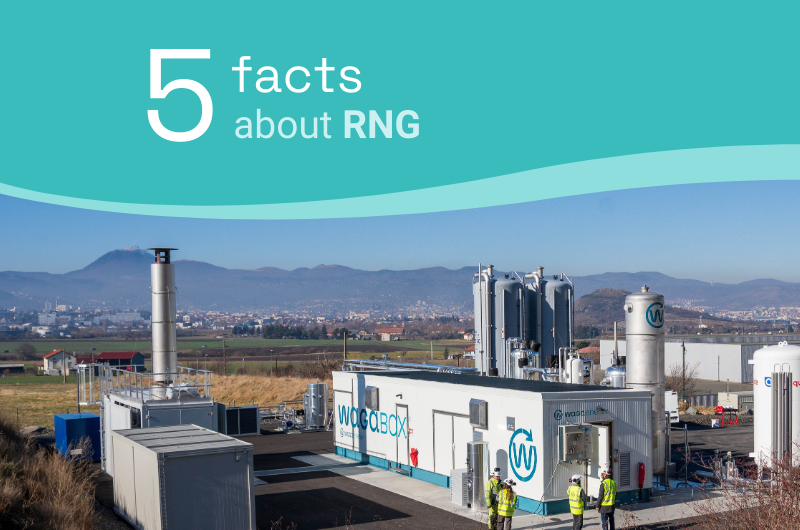
By valorizing gas emitted from landfilled waste, the WAGABOX® technology can produce RNG at competitive prices. At large landfill sites, this renewable gas can be sold under private purchase agreements (“RNG Purchase Agreement”), independently of any public support mechanism.
Advantages of RNG Produced at Landfill Sites
RNG obtained via the WAGABOX® process from landfill gas is chemically identical to RNG produced by anaerobic digesters or wastewater treatment plants. Its methane content reaches 97%, providing a calorific value equivalent to high-calorific natural gas (“H Gas”). It also meets injection criteria for grid operators in most countries (CO2, oxygen, sulfur content, etc.). Where no gas network is nearby, it can be compressed and transported by road (“trucked gas”).
The WAGABOX® process also reliably and cost-effectively reduces fugitive methane emissions at landfill sites, which are potent contributors to global warming (methane’s warming potential is up to 80 times higher than CO2). Due to the lack of a reliable measurement methodology, this impact is currently not included in the emissions savings reported by Waga Energy.
RNG Produced by Waga Energy: Certified Green Value
Various certification mechanisms allow buyers to recognize RNG purchases in their environmental reporting and obtain regulatory or fiscal benefits.
In Europe, Waga Energy’s RNG is ISCC-certified (International Sustainability and Carbon Certification), verifying compliance with sustainability and greenhouse gas reduction criteria defined in the EU RED II directive. This certification provides access to EU ETS quota exemptions or carbon tax reductions, depending on national regulations.
In France, Waga Energy was the first company to issue Biogas Production Certificates (CPB), certifying the green value of the gas and allowing them to be traded independently of the molecule.
In the United States, RNG produced by Waga Energy qualifies under the federal Renewable Fuel Standard (RFS). Classified as a cellulosic biofuel, it generates credits usable to decarbonize transport activities.
Waga Energy can commercialize RNG with or without associated certificates, depending on the buyer’s needs.